Rotary Rack Oven vs Deck Oven: Which Fits Your Bakery Production?
A Practical Comparison of Rotary Rack Ovens and Deck Ovens: How Each Heats and Loads, Where Each One Fits, and How to Choose for a Wholesale Plant, a Central Kitchen or an Artisan Bakery
2026/11/13
Reading volume: 0
News Details
What's the difference between a deck oven and a rotary rack oven?
Both deck ovens and rotary rack ovens bake bread, but they are built around different production models. A deck oven stacks independent baking chambers, each with its own heat settings. A rotary rack oven loads a whole trolley of trays into a single chamber and rotates that rack through the heat. The choice is therefore less about which type is better in general and more about which production model a bakery actually runs: a wide menu in moderate batches, or a narrow product range at volume.
How a deck oven bakes
Deck ovens transfer heat mainly by radiation and conduction from the deck surface, with additional heat from above. On a triple-deck model each chamber has its own micro-computer panel and separate top and bottom temperature settings, so a bakery can bake crusty loaves on one deck while a tray of pastries bakes to a different profile directly above. Double-pane glass doors and interior lighting let the baker follow colour without opening the door, which matters when a bake is judged by eye rather than by timer alone.
Loading is manual and tray by tray, so throughput depends as much on the baker's rhythm as on the oven itself. That is a disadvantage when the day is thousands of identical rolls, and an advantage when the menu changes from morning to afternoon.
Where deck ovens earn their keep
- Artisan bread and sourdough, where strong bottom heat and a defined crust are the selling point.
- Pizza and flatbread, which rely on direct contact with the deck.
- Mixed menus in one shift: bread in the morning, pastries at midday, savoury items later.
Our range of commercial deck ovens covers single, double, triple and four-deck builds, including glass-door and base-rack combinations, so capacity can be added one deck at a time.
How a rotary rack oven bakes
A rack oven accepts a loaded trolley straight from the proofer over a low stainless ramp, then rotates the entire rack through the chamber while high-velocity air circulates. Because every tray passes through the same zones in the same order, browning and volume stay even from the top tray to the bottom, which is the main reason wholesale plants standardise on this format. Steam is normally integrated: our industrial rack oven uses a steam battery to release moisture at the start of the bake, supporting oven spring and gloss on baguettes and crusty loaves.
Loading is also a practical argument. One operator wheels in a rack instead of filling decks pan by pan, and the same trolley can travel from proofer to oven without being unloaded.
Where rack ovens earn their keep
- Wholesale bread, buns, toast loaves and dinner rolls in continuous daily runs.
- Pastry factories that need uniform batches across many trays.
- Central kitchens supplying several outlets, where batch-to-batch consistency protects the brand.
Side-by-side comparison
| Aspect | Deck oven | Rotary rack oven |
|---|---|---|
| Heating method | Radiant and conduction heat from each deck, plus top heat | Circulating hot air around a rotating rack, with injected steam |
| Loading | Tray by tray, manual | Whole trolley rolled in on a ramp |
| Temperature zoning | Independent per deck, top and bottom | One chamber, one profile per bake |
| Product fit | Artisan bread, pizza, mixed menus | Bread, buns, rolls, pastries and cakes at volume |
| Labour per tray | Higher, and skill dependent | Lower, because handling happens once per trolley |
| Installation | Stacks vertically, modest ceiling height | Needs trolley clearance, ramp and stronger extraction |
| Growth path | Add decks or a second oven | Larger rack or extra trolleys |
A third option: convection ovens
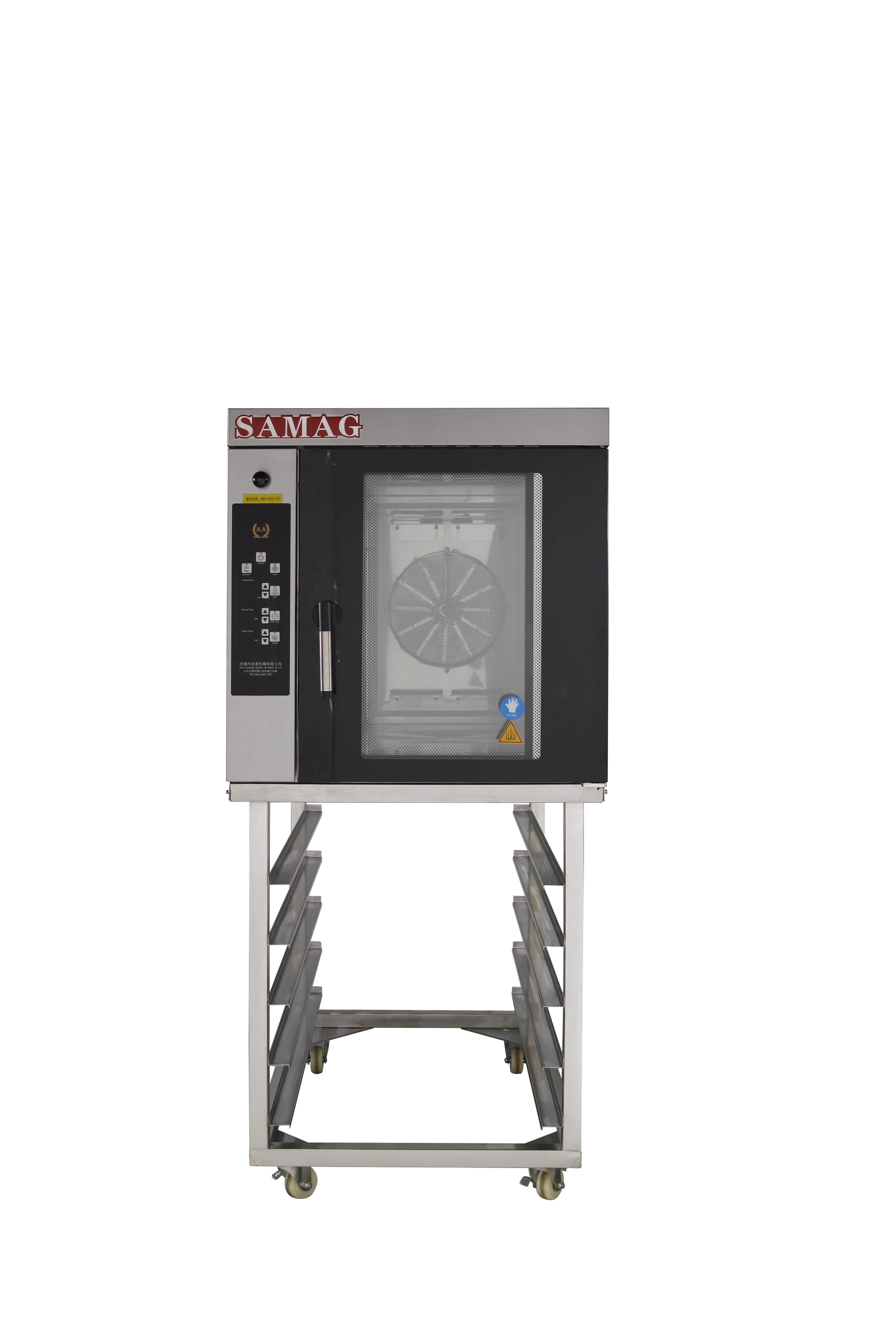
When daily volumes sit between the two, an electric convection oven often does the work for less capital. Our convection ovens hold 8 to 10 trays, use dual fans for even air movement and include a built-in steam system, with a stand that brings the chamber to working height. They bake consistently and recover quickly, but they suit tray-based production rather than trolley logistics.
Matching the oven to the production model
Five questions usually settle the choice:
- How concentrated is the product range? When a large share of output is one or two products, rack loading starts to pay for itself in labour.
- How often does the menu change? A deck oven wins when several products with different profiles run at the same time.
- Who loads the oven? Bakers who judge colour by eye tend to prefer decks; new staff adapt faster to racks.
- What does the building allow? Decks stack vertically and need less height; rack ovens need trolley clearance, a ramp and stronger extraction.
- Where will the bakery be in three years? Buying one size up is usually cheaper than rebuilding the bake line twice.
Purchase price is not the running cost
Two costs are easy to miss in a quotation. The first is labour: a deck oven consumes baker hours on every tray, while a rack oven spends them once per trolley. The second is energy behaviour at part load. A rack oven is efficient when it runs full chambers back to back; run half empty, and the advantage narrows quickly. A deck oven lets a small bakery heat only the decks it needs, which is why artisan shops often stay with decks even when they could afford a rack.
Running both
Many bakeries never choose. A rack oven carries the volume lines, while a two or three-deck oven handles sourdough, specialty breads and finishing work where crust is the product. The two share extraction, steam supply and tray standards, and the split keeps expensive rack capacity free for the products that genuinely need throughput.
What to send a supplier
An oven quotation is only as good as the brief behind it. The useful inputs are expected daily output by product, dough weight per piece, tray size and trays per rack, bake time and temperature, shift pattern, steam and extraction provisions, available power or gas, and a floor plan with ceiling height.
We build bakery equipment in Wuxi and also plan factory layouts, so a brief like this can be turned into a line proposal instead of a single machine quote. If you are comparing both formats, send the numbers and we will size each option against the same output target.
Share to:


