Bakery Production Line Planning: Matching Mixer, Proofer and Oven Capacity
A step-by-step approach to planning a bakery production line: set a realistic output target, size mixing, sheeting, proofing and baking, and identify bottlenecks before ordering equipment.
2026/11/13
Reading volume: 0
News Details
Start with the order book, not the equipment list
Most bakery projects begin with a list of machines and a budget. The list usually comes back twice, because a line is not a collection of good machines but a chain that moves dough at one rhythm from the mixer to the cooling rack. The first number to fix is therefore not a machine size but a realistic daily output: kilograms of dough per shift, the share of each product, and the hours available to produce it. Everything else is sized against that figure.
Two adjustments keep the number honest. Add a buffer for peak days, and check whether the target assumes one shift or two. A line sized for a single shift with no buffer is a line that fails on the first holiday order.
Stage 1: mixing sets the rhythm
The mixer defines the batch, and the batch defines everything downstream. A spiral mixer works by rotating the bowl and the spiral arm in opposite directions, which develops gluten quickly while keeping dough temperature down. Our fixed-bowl spiral dough mixer uses dual-speed motors and two digital timers, so the slow and fast stages can be set once and repeated exactly. Removable-bowl versions add a second bowl, which lets one batch prove while the next is mixed.
To size mixing, take the batch weight and the full cycle time, including loading and discharge:
Batches per shift = available minutes ÷ (mix minutes + load and unload minutes)
Then check that batches per shift multiplied by batch weight covers the daily dough requirement. If it does not, the choice is a larger bowl, a second mixer, or a longer shift - in that order of cost.
Stage 2: sheeting and shaping between mixer and proofer
Not every line needs a sheeter, but lines making laminated pastry, croissants, pizza bases or sandwich bread usually do. A sheeter replaces a manual rolling step that is slow, inconsistent and hard to staff. Our floor-standing dough sheeter uses a precision roller gap adjustment and reversible belts, with foldable catch wings so the machine can be pushed back when it is not in use; a compact tabletop version covers smaller pastry output.
The planning point here is space and flow rather than capacity. The sheeter must sit between the mixer and the bench, with clear floor in front for the operator and room behind for a dough trolley. A sheeter placed across a walkway costs more in lost minutes than it saves.
Stage 3: proofing is the stage most often undersized
Proofing is where new lines quietly lose capacity, because a proofer is bought as a cabinet rather than calculated as a buffer. The number that matters is how many trays must be in proof at any moment:
Trays in proof = trays per hour entering the oven × proofing minutes ÷ 60
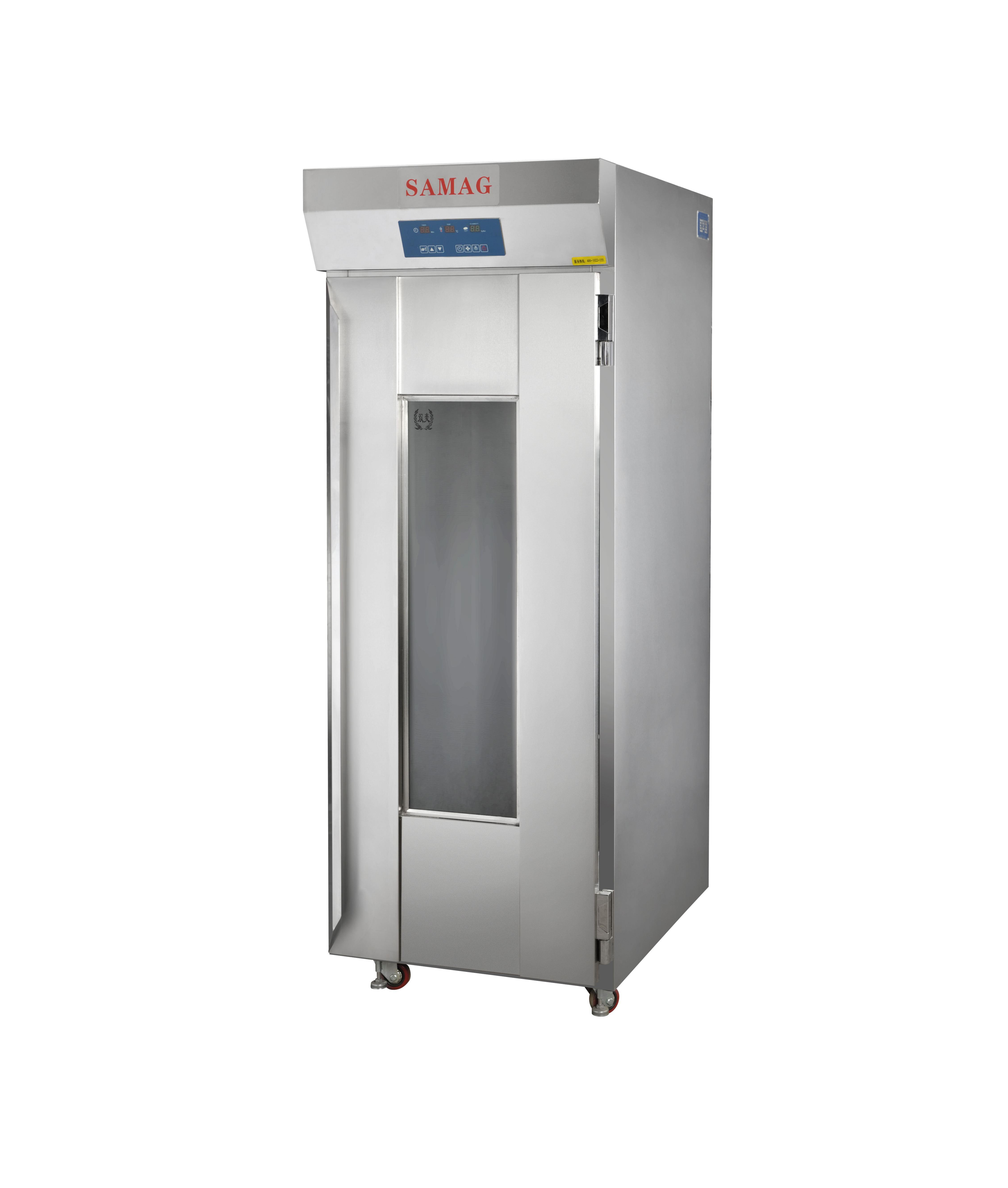
If the oven bakes 20 trays an hour and dough needs 60 minutes of proof, the proofer must hold 20 trays at once with nothing else in it. Add the trays being loaded and unloaded, and the cabinet is already tight. This is why split-compartment proofers are useful: our bread proofing cabinets are available in single and double-door versions with independent temperature and humidity control, so two products can prove on different schedules in the same footprint.
Stage 4: baking and the load pattern
The oven converts proofed trays into finished product, and its throughput is set by trays per load and bake time:
Trays per hour = trays per load × 60 ÷ bake minutes
The load pattern decides the labour bill. A deck oven is loaded tray by tray, so every bake consumes operator time. A rack oven is loaded once per trolley, which is why it is the usual choice above a certain volume. Whatever the format, the oven must recover temperature between loads; a line planned at the theoretical bake time with no recovery margin will run late every day.
Find the bottleneck before you buy
Overall line capacity equals the slowest stage, not the sum of the machines. Calculate each stage separately, then compare. The useful discipline is to write the four numbers down before ordering anything.
| Stage | What sets its throughput | What to measure | First fix if it is the constraint |
|---|---|---|---|
| Mixing | Batch weight and cycle time | Batches achieved per shift | Second bowl, larger bowl, or a second mixer |
| Sheeting and shaping | Roller speed and operator handling | Pieces or dough weight per hour | Move the machine into the flow, add a second bench |
| Proofing | Trays held and proofing time | Trays in proof at peak hour | Extra cabinet, split compartments, retarder to spread the load |
| Baking | Trays per load and bake time | Trays per hour at full load | More decks, a rack oven, or a second oven |
Layout, utilities and workflow
Sequence follows process: storage, mixing, dividing and shaping, proofing, baking, cooling, packing. Dough should move forward through that sequence without crossing itself, and the wet and dry sides should stay apart. Three practical checks catch most layout errors:
- Trolley turning circles and door widths - a rack oven ramp that a loaded trolley cannot reach is useless capacity.
- Extraction and heat - ovens need hoods sized to the chamber, and the baking area needs air that a proofer's humidity does not fight.
- Power and services - mixers and ovens draw differently, and the distribution board is easier to plan before the floor is laid than after.
Write the plan to scale. A line that works on paper at one square metre per machine rarely works on a real floor with doors, columns and drains.
What a line plan should contain
A plan a supplier can quote from includes: daily dough requirement and product mix, batch size and cycle times, tray format, proofing and bake times, shift pattern, available floor area with a sketch, ceiling height, power and gas supply, and the growth expected in two to three years.
We manufacture bakery equipment in Wuxi and also carry out factory planning and layout design, so a brief of this kind can be answered with a matched line rather than four separate machine prices. Send the output target and the floor plan, and the first useful answer is usually which stage of your line will become the bottleneck first.
Share to:


