Steam in Bread Baking: What It Does and How Ovens Deliver It
<p>What steam actually does in a bread bake, when to apply it, how deck, rack and convection ovens deliver it differently, and how to spot over-steaming before it reaches the shelf.</p>
2026/11/17
Reading volume: 0
News Details
Steam affects the crust, not the crumb
Two loaves from the same dough, baked in the same oven at the same temperature, can come out looking like completely different products. The difference is usually steam in the first minutes of baking. Steam keeps the dough surface moist and pliable while the loaf expands, so the scores open up rather than sealing over, and the starch on the surface gelatinises into a thin, glossy shell. Once the surface dries, the crust sets and the colour develops.
What steam doesn't do is make the bread softer inside. Crumb texture comes from fermentation, gluten development and baking time. Steam is a surface treatment, which is why a bakery can improve the appearance and volume of its bread without changing the recipe at all.
The first minutes determine the crust
The effective window is short. Steam matters while the dough is still expanding and the surface is still wet: roughly the first quarter of the bake. After that, the crust has set and excess moisture only softens it again, resulting in a dull, leathery finish instead of a crisp one.
This timing explains a common complaint. A bakery adds steam, sees glossier loaves, then reports that the bread goes soft within hours. The usual cause is steam running too long or venting too late, so the crust never dries. The solution is not less steam at the start, but a clean end to it: turn off the steam, open the damper or vent, and let the final part of the bake drive off the moisture.
Three ways an oven delivers steam
The mechanism varies by oven type, and it changes how much control the baker actually has.
Deck ovens
In a deck oven, steam is usually introduced into each chamber separately, either from a built-in steam function or via a water tray or injection system. Because every deck has its own controls, a bakery can steam rye bread on the bottom deck while baking a dry product above it. The limitation is labour: steam has to be started and stopped per deck, per bake, so consistency depends as much on the baker's routine as on the oven.
Rack ovens
A rack oven typically uses an integrated steam system that releases moisture into the chamber at the start of the cycle, timed from the same panel that controls the bake. With a full trolley inside and the door closed, the steam is distributed by the circulating air, which is why rack-baked loaves brown evenly from the top tray to the bottom. Our industrial rack oven uses a steam battery for this stage of the bake, with the rack rotating through the chamber so every tray is exposed to the same conditions.
Convection ovens
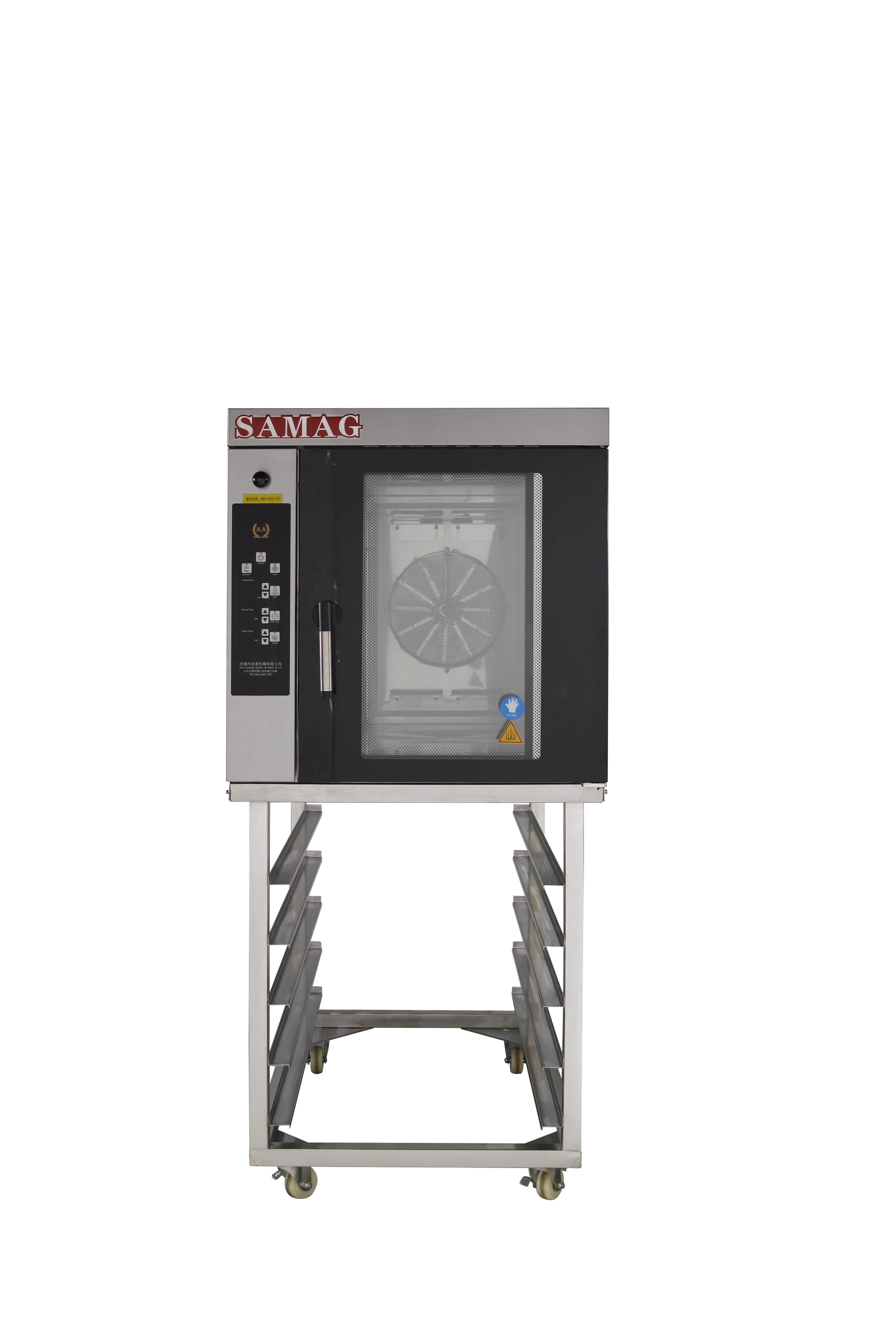
Electric convection ovens often include a built-in steam system alongside dual fans. Steam and air movement together give a compact oven a surprising level of crust control, which is why pastry and bread shops with limited floor space use them for baguettes and small loaves as well as for laminated products. Our convection ovens hold 8 to 10 trays in a stacked configuration and integrate the fans with a built-in steam system.
What too much steam looks like
Over-steaming has a characteristic that is easy to recognise once you know it:
- Flat, pale loaves with a dull surface instead of a glossy one.
- Small blisters or a mottled, watery sheen on the crust.
- Bread that bends rather than crackles when it cools.
- Loaves that stick to the peel or the tray, because the base never dried.
Under-steaming is equally noticeable: scores that have sealed shut, a crust that set before the loaf finished expanding, and a finished product that is noticeably smaller than the same dough baked with steam.
Steam, extraction and the room
Every kilogram of steam that enters the oven eventually leaves it. In a small room with poor extraction, that moisture condenses on cool surfaces: walls, extraction hoods, control panels and the floor. Over months, this is what corrodes electronics and turns a bakery floor into a slip hazard.
Three practical points follow. Extraction should be sized for the steam load, not just for heat; hoods should capture steam at the oven mouth rather than above the aisle; and the oven should not be placed directly under a cold air inlet, where condensate drips back onto the machine. If the oven has a factory-fitted top canopy hood, as on our glass-door deck models, use it as part of the extraction design rather than as a substitute for it.
Building steam into the bake schedule
Steam is a schedule item, not a switch. A practical routine looks like this: load quickly and close the door, apply steam for the opening phase of the bake, vent to dry the crust, then finish on dry heat for colour. Write the steam minutes next to the bake time on the production sheet, because the person loading at five in the morning is not always the person who set up the oven.
For mixed production, group products by steam requirement rather than by shape. Breads that need a heavy steam opening can share a deck or a rack; products that need a dry bake - biscuits, some enriched doughs, meringue - should follow them, not run alongside.
What to ask a supplier
Questions that yield useful answers: is steam built in or added via a tray, how is it triggered and timed, can each deck be steamed independently, what is the recovery time between bakes, what extraction does the oven need, and what water quality does the steam system require. Hard water is the silent enemy of steam systems; if the local supply is mineral-rich, ask about filtration before the machine is installed rather than after the first service call.
We build commercial deck ovens, rack ovens and convection ovens in Wuxi, and we also plan bakery layouts, so the steam and extraction design can be checked against the room before the oven is ordered.
Share to:


