Bread Proofer Guide: Temperature, Humidity, and Tray Capacity
Bread Proofer Guide: Temperature, Humidity & Tray Calculation Explained
2026/11/13
Reading volume: 0
News Details
What a proofing cabinet actually controls
Proofing is fermentation at a controlled pace. A cabinet maintains a warm, humid environment to let shaped dough relax and rise before baking, and its function is to keep two variables stable: temperature, which determines how fast the yeast works, and relative humidity, which prevents the surface from drying out. Everything else — door count, tray slides, controls, casters — exists to keep these two values constant while trays are moved in and out.
This definition is useful when comparing catalogs, as most proofer specifications list capacity and panel features but say little about how well the cabinet maintains its climate after the door has been opened twenty times during a shift.
Humidity matters more to the crust than heat does
If the air is too dry, the dough surface forms a skin. This skin resists expansion in the oven, causing the loaf to tear at the base or remain small, and a baguette loses the gloss that customers associate with freshness. Too much humidity brings its own problems: condensation forms on the canopy, drips onto the top trays, and leaves a wet, blistered surface or causes dough to stick to the pan.
The practical difference between a good and a mediocre cabinet is therefore rarely the heater. It is the door seal and insulation. Tight magnetic gaskets, insulated stainless steel panels, and a heated water tray or humidifier keep the internal climate stable when the door opens, instead of letting a wave of dry room air enter every time a rack is loaded. The same reasoning explains why a cabinet placed in a cold, drafty corner struggles to perform even when its panel shows the correct temperature.
Size it by trays in proof, not door count
A proofer is usually purchased as a cabinet and should be calculated as a buffer. The key figure is how many trays must be in the chamber at any given time:
Trays in proof = trays per hour entering the oven × proofing minutes ÷ 60
If the oven bakes 20 trays per hour and the dough requires 60 minutes of proofing, the cabinet must hold 20 trays at once — with nothing else inside. Add the trays being loaded and unloaded, plus one product waiting behind another, and a 20-tray cabinet is already full at the start of the shift. This is the single most common planning error on a new line: the oven is specified with headroom, but the proofer is not.
The solution is not always a larger cabinet. A retarder that holds dough overnight spreads the load; a second, smaller proofer for a second product line separates two schedules; and a split-control cabinet does both in one footprint.
Single door, double door, or two separate climates
| Configuration | How it performs | Suitable for |
|---|---|---|
| Single door, single chamber | One climate for the entire cabinet; opening the door affects every tray | Shops running one dough type on one schedule |
| Two doors, shared climate | Higher capacity, but both chambers move together | One product at high volume |
| Two compartments, split control | Two independent panels and isolated chambers; loading one leaves the other unaffected | Sourdough alongside enriched dough, or staggered batches |
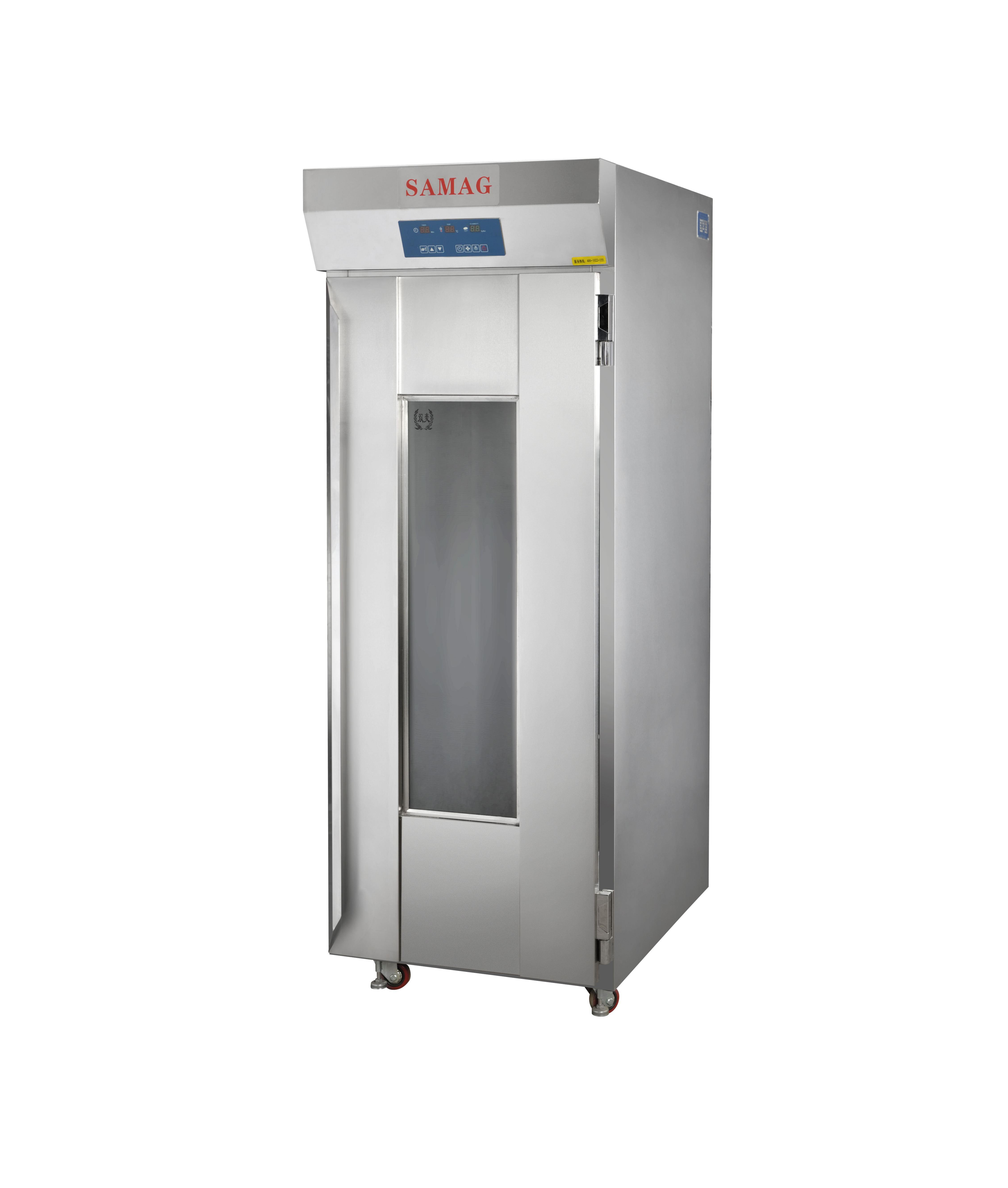
Our bread proofing cabinets are available in all three layouts. The single-door dough proofer maintains a simple climate with one panel and a full-height glass door, while the split-control proofer provides separate micro-computer panels for the upper and lower chambers, allowing two products to proof on different schedules in the same floor space.
Proofer or retarder: two different functions
The two machines are often confused because both hold trays of shaped dough. A proofer warms and humidifies to accelerate fermentation; a retarder chills dough to slow it down, typically so that work done in the evening can be baked in the morning without a night shift. Neither replaces the other. A bakery that wants fresh bread at six o'clock either starts at three in the morning or uses a retarder — and this decision affects staffing more than equipment cost.
If both are needed, plan them as two units side by side, with the retarder close to the shaping area and the proofer close to the oven. A combined retarder-proofer exists, but it operates one climate at a time, so it cannot hold a chilled batch and a proofing batch simultaneously.
Placement determines how well it works
- Distance to the oven. Proofed dough is fragile. Every meter and every door between the cabinet and the oven is an opportunity to knock a tray.
- Door swing and cart turning radius. Check the door's arc against the rack you actually use, not the one shown in the catalog.
- Ambient conditions. Ovens draw in air and generate heat; a proofer placed in that draft will struggle all day.
- Floor and drainage. Humidity means condensation. A floor that stays wet under the cabinet will eventually lead to electrical issues.
- Access for cleaning. Trays and chamber walls need wiping; casters make this possible without dismantling the line.
What to send to a supplier
A proofer quotation is only useful when it is matched to a schedule. Send the products you proof, tray size and trays per rack, proofing time for each product, trays per hour going into the oven, shift pattern, room temperature in winter and summer, available space, and door width along the route. With these numbers, a supplier can determine chamber size and control layout; without them, every cabinet looks sufficient on paper.
We manufacture bakery equipment in Wuxi and also plan factory layouts, so the same brief can be checked against your oven capacity — the point at which a line usually reveals whether the proofer or the oven will limit output first.
Share to:


