Commercial Dough Sheeter Buying Guide: Roller Gap, Belts and Throughput
How to choose a commercial dough sheeter for croissants and puff pastry: roller gap control, reversible belts, tabletop versus floor-standing formats, and the pass-by-pass arithmetic behind real throughput.
2026/11/13
Reading volume: 0
News Details
What a dough sheeter does that a rolling pin cannot
Laminated dough is an alternating stack of dough and butter. A rolling pin applies uneven pressure, warms the butter with the baker's hands and pushes the block outwards in some places more than others. A dough sheeter passes the block between two hard rollers set to a fixed gap, so thickness is even across the full width and the butter stays in flat, unbroken layers. The difference only shows up later, in the oven: even lamination rises evenly, while broken layers leak butter and bake flat.
That is why the machine is judged on two things - how precisely the gap can be set and repeated, and how easily the dough is returned for the next pass.
Roller gap is the number that decides pastry quality
Every block is reduced in steps, not in one pass. Take too much at once and the butter layer tears or squeezes out at the edges; take too little and the dough warms up over twenty extra passes. A practical rule is to reduce thickness gradually, checking the sheet at the edges rather than in the middle, where the rollers flatter the dough most.
The hardware that makes this repeatable is a gap lever with an indexed scale, and on better-specified machines a digital thickness readout. Hard-chromed, seamless rollers matter as much: a polished, non-stick surface keeps cold butter from dragging, and the roller's mass holds its shape under load, so the sheet comes out the same width from the first pass to the last.
Belts, reversal and two free hands
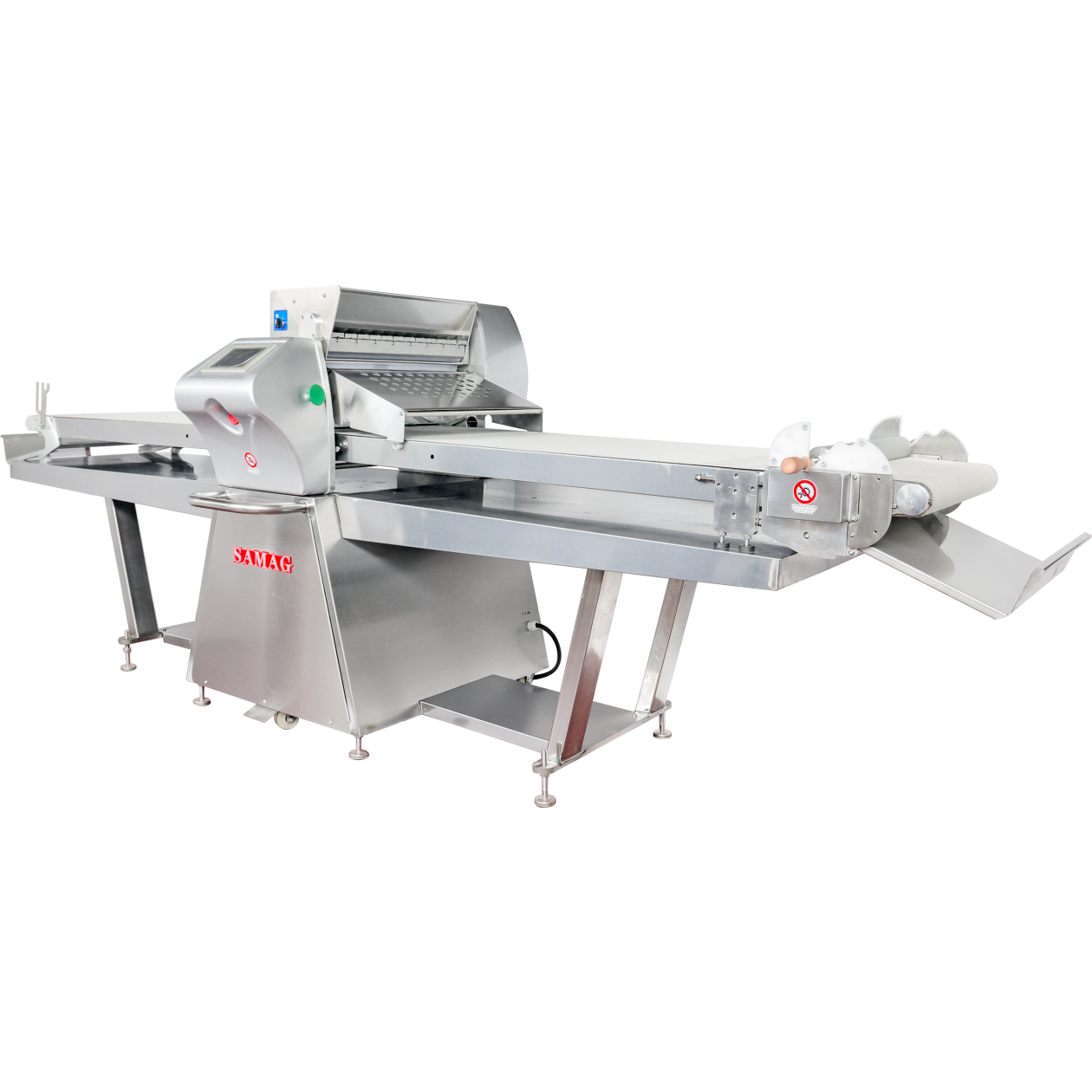
A one-direction sheeter forces the operator to walk around the machine or lift the dough back to the start after every pass. A bi-directional conveyor reverses the belts instead, so the block travels back and forth without being handled. On a floor-standing machine this is usually controlled by a foot pedal, which leaves both hands free to guide the sheet straight into the rollers - the difference between a square block and a trapezoid after eight passes.
The other handling feature worth checking is the wings. Conveyor side tables that fold up vertically let the machine sit against a wall when it is idle, which in a small pastry kitchen is often the deciding factor between a floor-standing unit and a tabletop one.
Tabletop or floor-standing
| Aspect | Tabletop | Floor-standing |
|---|---|---|
| Dough block size | Small to medium blocks, short conveyor beds | Large blocks, long beds that hold a full sheet |
| Output | Boutique shops, cafes, dessert menus | Croissant and puff pastry production, central kitchens |
| Control | Hand lever and toggle switch | Foot pedals and hands-free reversing |
| Space when idle | Folds up onto the bench | Wings fold vertically, base stays on casters |
| Best fit | Under 100 kg of laminated dough a day | Daily production with a fixed pastry section |
Our dough sheeters cover both formats. The floor-standing dough sheeter pairs a micro-calibrated gap lever with dual foot-pedal reversing and vertically folding wings, while the tabletop dough sheeter keeps the same roller principle in a shorter bed that lifts off the bench when the shift ends.
Throughput: count passes, not kilograms
A sheeter's output is often quoted in kilograms per hour, which tells you very little. What actually takes time is the number of passes, and that is set by the recipe and the final thickness.
Minutes per block = passes × (pass time + handling time)
Blocks per hour = 60 ÷ minutes per block
For a croissant base that is eight to ten passes per block, plus a rest in the chiller between folds and a minute or two of handling at each stage, the arithmetic is dominated by the rests, not the rollers. A faster machine does not remove a single rest, so the honest measure of capacity is how many blocks can be in progress at once, given the chiller space available. Buy the sheeter for the width and control it offers, and plan the chiller for the throughput you need.
Temperature discipline between passes
Butter has a narrow working range. Too warm and it merges into the dough, losing the layers; too cold and it cracks and breaks through the sheet. Every pass adds a little heat through friction and handling, which is why laminated production is organised around short working windows and rests in the chiller rather than around a single continuous run.
Two habits help. Keep the pastry room cool and out of direct sun, and keep the flour used for dusting to the minimum that stops sticking - excess flour sits between the layers and turns into a dry, grey band after baking. A sheeter with non-stick rollers needs very little dusting, which is one of its quieter advantages.
Safety, cleaning and belt care
- Roller guards that cut the motor as soon as they are lifted, on both the infeed and the return side.
- No knives, scrapers or wire brushes on the belts; a torn belt tracks badly and marks every sheet after it.
- A daily wipe of the rollers and a check of belt tension; dough residue on a roller is the usual cause of a torn sheet.
- Casters with floor locks, so the machine stays put during a pass but can be moved for cleaning underneath.
What to send a supplier
Useful inputs for a sheeter quotation: the products you laminate, the maximum block weight and dimensions, the final sheet thickness, the width you need to cover your moulds, kilograms per day, the bench or floor space available, and the power supply. Send those and the answer becomes a specific machine width and bed length rather than a general price list.
We build bakery equipment in Wuxi and also plan bakery layouts, so if the sheeter has to sit between a mixer and a proofer, the same brief can be used to check the flow of the whole pastry section.
Share to:


