Commercial Spiral Dough Mixer Buying Guide: Bowl Size, Speed and Batch Logic
How to size a commercial spiral dough mixer: batch weight versus bowl capacity, fixed versus removable bowls, speed and timer control, dough temperature, and the details that decide reliability after the first year.
2026/11/13
Reading volume: 0
News Details
Why the spiral mixer became the default
A spiral mixer turns the bowl in one direction and the spiral tool in the other. Dough is stretched and folded between the two rather than pressed against a fixed bowl, so the gluten network forms quickly while the dough temperature climbs more slowly than in a planetary mixer. That is why the format dominates bread, baguette, pizza and brioche production, and why most buying decisions come down to size, bowl handling and control rather than to the mixing principle itself.
Size the bowl from the batch, not from the flour bag
Mixers are quoted by bowl capacity, and bowl capacity almost always means flour weight, not dough weight. The gap is large: fifty kilograms of flour at 60% absorption gives roughly 80 kg of dough, and a wet sourdough at 80% gives about 90 kg. A bakery that orders on dough weight can end up with a bowl a third too small, and a machine loaded to its limit on every batch runs hotter and wears faster.
Convert the batch into a shift before comparing models:
Batches per shift = available mixing minutes ÷ (mixing minutes + loading and unloading minutes)
Dough per shift = batches per shift × batch weight
Loading and unloading is the part buyers forget. Emptying a stiff dough from a fixed bowl and scraping it down takes several minutes; a removable bowl leaves the machine with the dough still in it. Multiply that difference by twenty batches a day and it often outweighs the difference in motor rating.
Fixed bowl or removable bowl
Both formats mix to the same standard. They differ in what happens between batches.
| Aspect | Fixed bowl | Removable bowl |
|---|---|---|
| Changeover between batches | Empty and scrape in place, then reload | Hydraulic head lift, bowl rolls away on its trolley |
| Dough transport | Manual transfer to the bench or trough | Dough travels in the bowl to the divider or resting area |
| Floor space | One footprint per mixer | One base plus parking space for each spare bowl |
| Best fit | Single-shift shops, mixed menus, pizza and bagel doughs | Multi-shift plants, long fermentation, dough rested in the bowl |
| Cost | Lower per kilogram of capacity | Higher, but spread over several bowls |
Our spiral dough mixers are built in both formats. The fixed-bowl spiral mixer uses a dual-speed high-torque motor and two digital timers so the slow and fast stages switch automatically, with a safety cage that cuts rotation as soon as it is raised. The removable bowl mixer adds a hydraulic head lift and an independent wheeled bowl trolley, which is what makes one base practical for several bowls.
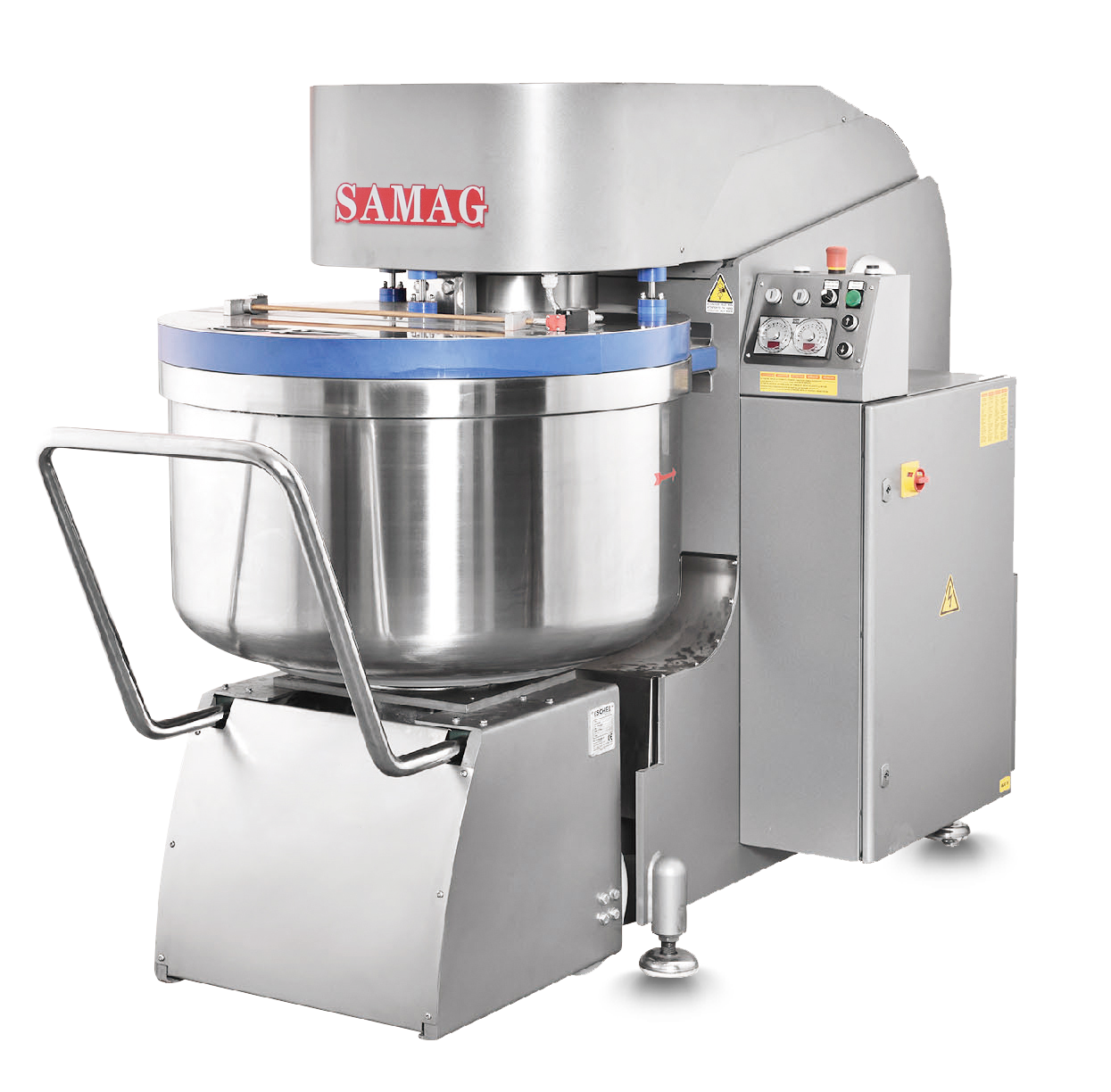
Speeds, timers and dough temperature
Two speeds are standard, and they do different jobs. Low speed hydrates the flour and brings the batch together without throwing it up the bowl; high speed develops the gluten. The useful question is not how many speeds a machine offers but whether the change between them can be timed. Digital timers that switch from slow to fast automatically turn a baker's judgement into a repeatable programme, which is what makes a Friday batch taste like a Tuesday batch.
Temperature is the second half of the same problem. Every minute of high-speed mixing adds friction heat, and a dough that finishes above its target ferments faster than the schedule assumes. In practice this is controlled by three habits: chill the water rather than the flour, mix the minimum time the gluten needs, and keep the batch size inside the bowl's rated range rather than filling it to the rim. A machine that is consistently overloaded cannot be rescued by colder water.
Details that decide reliability in year three
- Guard interlock. A safety cage that stops the tool when lifted protects hands, but it also tells you the machine was designed for staff who will actually use it.
- Tool material and shape. A stainless spiral hook and central breaker bar resist wear and keep the dough moving instead of tearing it.
- Frame rigidity. Stiff dough at high capacity makes a light frame walk across the floor. A heavy cast frame is not cosmetic.
- Controls you can operate with wet hands. Clear buttons, a visible emergency stop and a manual override matter more than a touchscreen in a dough room.
- Spare parts. Ask which parts are stocked and how long a bowl or a timer is available after delivery.
Matching the mixer to the rest of the line
The mixer sets the rhythm for everything downstream, so the batch has to divide cleanly into what the proofer and the oven can take. A 90 kg batch that fills one rack is convenient; a 70 kg batch that leaves a third of a rack empty costs oven space every hour of the shift. Check the arithmetic in both directions before choosing the bowl: dough per batch against trays per rack, and batches per hour against oven loads per hour.
Where the line will grow, the cheaper decision is usually the smaller base with more bowls, not the larger base with one bowl. Capacity can then be added by mixing earlier, not by rebuilding the room.
What to send a supplier
A mixer quotation becomes useful when it is answered against real numbers. Send the doughs you make and their absorption, the batch weight you want, batches per shift, the flour specification, available power, the height of the room and the doorway, and where the dough goes next. If you are also planning a full line, include the floor plan; we build bakery equipment in Wuxi and support factory layout work, so the mixer can be sized against the proofer and oven instead of on its own.
Share to:


