Bakery equipment maintenance plan: mixer, proofer, and oven
A practical maintenance schedule for bakery equipment: what needs cleaning every shift, what should be inspected weekly and monthly, the common wear points on mixers, proofers and ovens, and which spare parts are worth having on hand.
2026/11/17
Reading volume: 0
News Details
Maintenance protects output, not just equipment
Bakery equipment rarely breaks down without warning. It loses performance first: an oven takes four minutes longer to recover, a proofer deviates by a few degrees, a mixer's timer no longer switches speeds reliably. None of these halts production, so no one reports them, and the line quietly runs below the capacity for which it was purchased.
A written maintenance schedule is the most cost-effective way to detect this degradation. It also separates two distinct tasks that are often confused: cleaning, which the crew performs every day, and inspection, which must be assigned to a specific person with a date and signature.
The rhythm: daily, weekly, monthly
| Frequency | Action | Responsible |
|---|---|---|
| Every shift | Wipe contact surfaces, empty crumb trays, check guards and interlocks, visually inspect cables and plugs | Operator |
| Weekly | Deep clean chambers and bowls, check door seals, clean vents and fans, inspect belts and rollers | Shift lead |
| Monthly | Check fasteners and levelling, test emergency stops, inspect seals and gaskets for wear, verify temperature accuracy | Maintenance team |
| Quarterly or seasonal | Descale or service steam and water systems, check extraction, replace worn gaskets, review spare parts inventory | Service partner |
The exact intervals depend on shift length and product mix, but the structure matters more than the calendar. Machines that are cleaned but never inspected fail in the same way as machines that are never cleaned.
Mixers: bowl, tools, guard, timers
A spiral mixer is mechanically simple, which is why neglect goes unnoticed for a long time.
- Bowl and tools. Dough residue left on the spiral hook hardens overnight and unbalances the tool. Wash the hook and breaker bar at the end of the shift, not at the start of the next one.
- Safety cage and interlock. Test weekly: lift the cage while the machine is running and confirm that rotation stops. An interlock that has been bypassed to save time is a serious hazard, not a convenience.
- Timers and speed changes. The slow-to-fast switch is the component that wears out. If it hesitates, the batch generates more frictional heat than the recipe accounts for.
- Frame and fasteners. Stiff dough causes a loose machine to shift. Check base bolts and feet monthly, especially on tiled floors.
- Bowl trolley (models with removable bowls). Castors and the hydraulic lift are wear points; a trolley that no longer locks properly will eventually damage the bowl seat.
The same discipline applies to any spiral dough mixer, fixed bowl or removable: the machine benefits more from a five-minute end-of-shift routine than from an annual overhaul.
Proofers: gaskets, water, chamber
Proofers fail gradually. The panel still displays the set temperature while the actual chamber temperature differs, usually because the door gasket has compressed or the water tray has scaled up.
- Wipe the chamber and trays daily; sugar and dough residue promotes mould growth in a warm, humid environment.
- Inspect the magnetic gasket weekly for hardening, cracks, and gaps on the hinge side.
- Clean or descale the water tray and humidifier on a fixed schedule - hard water is the main cause of humidity drift.
- Ensure that the drain or drip path is clear and that condensate is not draining onto the floor under the cabinet.
- Confirm that the internal circulation fan runs freely; a stalled fan causes different climate conditions on either side of the cabinet.
On a bread proofing cabinet with two compartments and separate controls, test each chamber individually. A fault in one panel is easy to miss if the other maintains its set point.
Ovens: doors, decks, vents, extraction
- Door seals and hinges. The most common cause of uneven browning and longer baking times. Replace gaskets before they fail completely.
- Deck surfaces. Remove burnt sugar and flour between shifts; a scratched or pitted deck bakes unevenly and cannot be corrected by adjusting the thermostat.
- Vents and dampers. Steam must escape the chamber. A stuck damper turns a crisp crust into a soft one.
- Extraction and hoods. Clean grease filters on a schedule; restricted extraction pushes heat and moisture back into the room and into the control panel.
- Control cooling. Side ventilation slots on modern ovens exist for a reason - keep them clear of trays, cloths and flour dust.
- Temperature verification. Compare the display with an independent probe monthly. Drift is gradual and invisible in the product until it becomes noticeable.
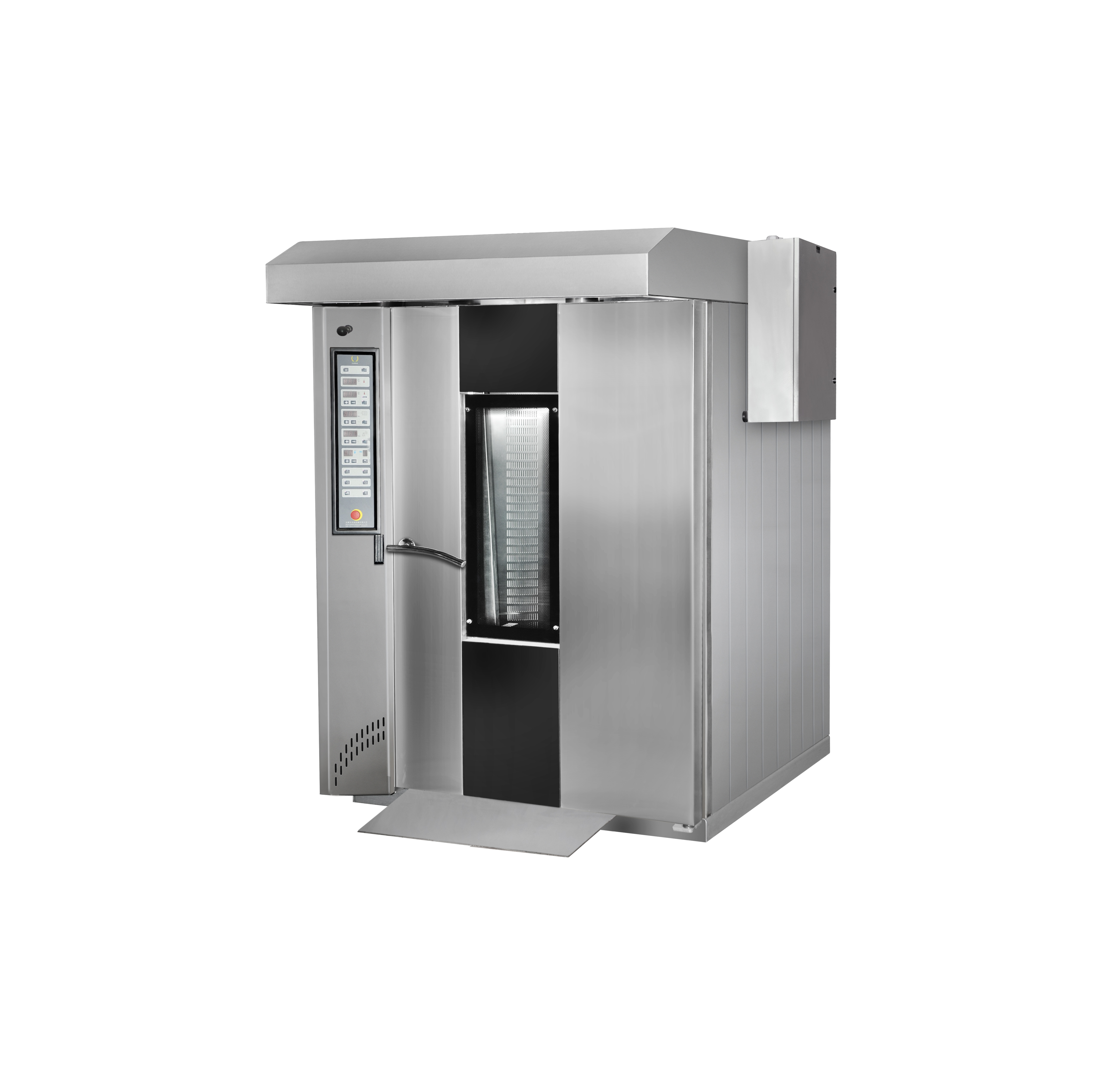
The same checklist applies to various models, including convection ovens, where the fans and steam system add two additional items: fan blades must be clean and balanced, and the steam circuit must be descaled on schedule.
Non-negotiable safety items
Some checks must be on the list regardless of production pressure: emergency stops on every machine, guard interlocks, cable condition, plug and isolator condition, and the physical stability of castors and feet. A machine that has been moved for cleaning and not properly locked back into place is a machine waiting to shift under load.
The practical rule is that a safety item is either functional or the machine is out of service. There is no middle ground, and no schedule can succeed if a team treats interlocks as an inconvenience.
Recommended spare parts to keep in stock
Downtime is usually a parts issue, not a repair issue. The parts that most often stop a bakery are inexpensive and predictable: door gaskets, oven door handles and hinges, proofer panel sensors, mixer timers and contactors, castors and belts. Keeping one of each on site costs less than a single lost morning.
What to document
Maintain one sheet per machine with four columns: date, check performed, finding, action. After six months, it will show which machine is drifting and which spare part you should have purchased. It also gives a service engineer better information than a verbal description when the machine finally stops working.
We manufacture mixers, proofers, deck ovens, convection ovens and rack ovens in Wuxi, and we can provide the recommended maintenance intervals and spare parts list for each model, so the schedule is tailored to the machine rather than based on a generic template.
Share to:


